01The problem
Indian advocates cannot advertise: Bar Council of India Rule 36 limits a firm's website to factual particulars, so the usual law-firm playbook of testimonials, awards and case wins is off the table. Families in Hyderabad still need plain-language information in their own language, and the firm needs a safe way to publish and review legal content per language. The template had to be useful and calm without crossing into solicitation, and clean enough to resell.
02Who it is for
Individuals and families in Hyderabad looking for legal information and an advocate; the firm's admins, editors and reviewers who publish content; developers or firms buying the template.
03Features
- English, Telugu and Hindi with locale URLs, hreflang and a language switch that stays on the same page
- BCI disclaimer gate on first visit (I agree / Leave site), re-openable from the footer
- 16 sample practice areas with overview, scope, process, documents checklist, forums and FAQs
- Advocate profiles limited to permitted particulars (enrolment no., Bar Council, qualifications, areas)
- Legal Resources: articles, FAQs, glossary and checklists with filter, search and pagination
- Locale-aware full-text search and a clear missing-translation notice
- Role-based CMS (admin / reviewer / editor) with per-language draft-review-publish workflow
- Revisions with restore, audit log, translations matrix and versioned legal notices
- Promo modules (testimonials, awards, stats, case highlights, enquiry form, newsletter) built but off by default
- Supabase Postgres with Row Level Security on every table; demo mode needs no backend
- Light and dark 'chalkboard' themes, self-hosted fonts and Material Symbols
- Designed for WCAG 2.2 AA, keyboard-friendly and reduced-motion aware
04Pages & screens
- Home
- About
- Advocates
- Advocate detail
- Practice Areas
- Practice Area detail
- Legal Resources (articles, FAQs, glossary, checklists)
- Article detail
- Search
- Contact / Office
- Careers (optional)
- Disclaimer, Privacy, Terms, Accessibility
- 404
- Admin: Login with password reset
- Admin: Dashboard, Pages, Practice Areas, Advocates, Articles, Categories
- Admin: Translations, Legal Notices, Settings, Users & Roles, Audit Log
05Stack
06How I built it with AI
Srini built this with an AI coding assistant, starting from his own written requirements spec (FSR) for a Hyderabad law firm and a mood board. His brief admitted he did not know the domain: "I don't know about how a law firm works, what services they provide, etc. So search internet for best law firms... It set the visual direction (
Use the combination black, grey and white as brand theme, follow dotted/dashed line and sharp edges and clear text") and the commercial goal (create it in such a way that i can sell this website template for sale. So take care of all copyrighted info.
). The AI first proposed its understanding and approach for approval, then built the frontend, the Supabase schema with RLS tests, the CMS and Playwright tests, and wrote the 20-guide documentation set, brand kit and marketplace listing shipped in LawFirmV0.1.zip.
07Design highlights
Compliance as a design constraint: promotional modules exist behind feature flags but ship switched off for BCI Rule 36, and advocate profiles show only permitted particulars
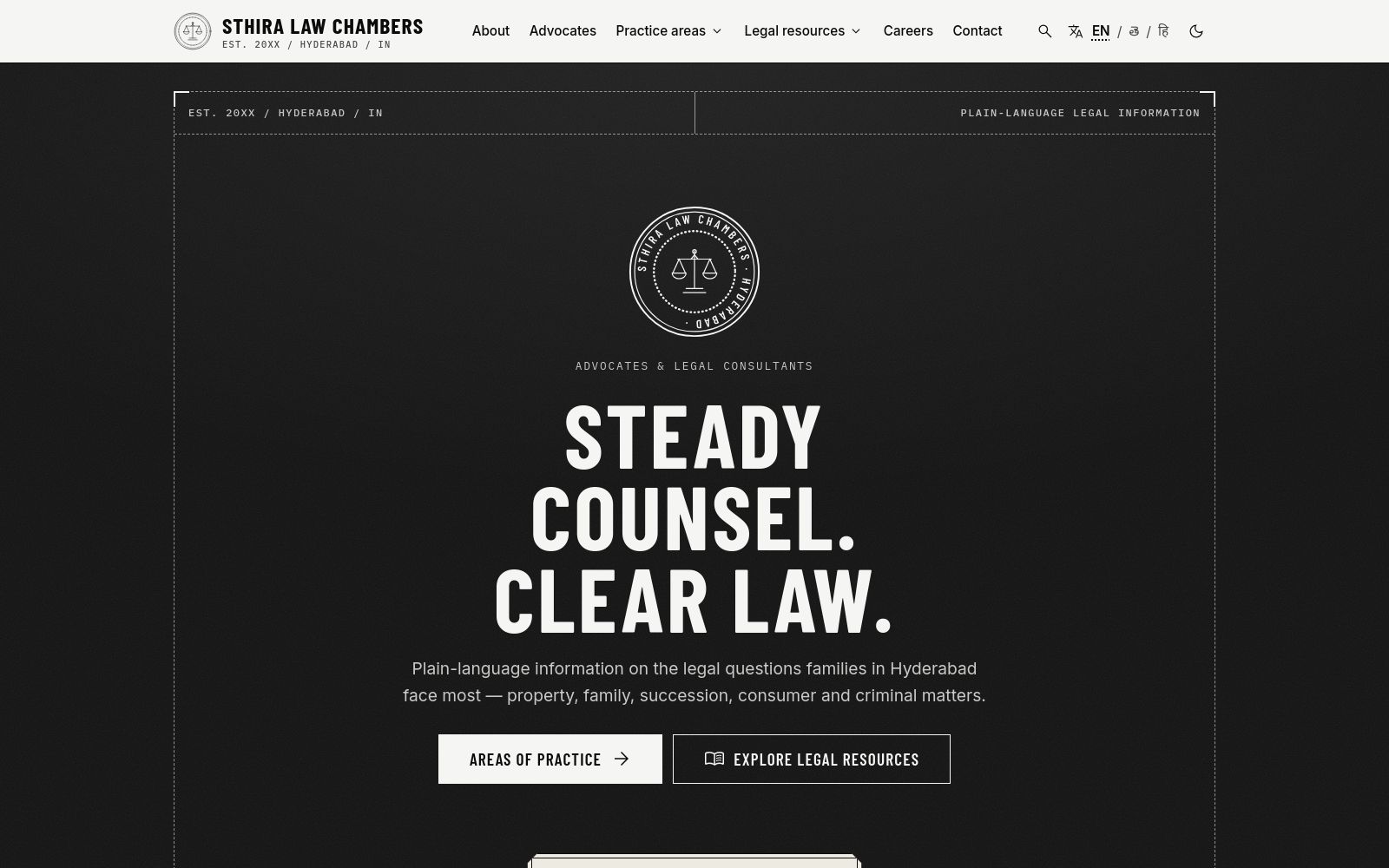
Monochrome identity from the mood board: corner-tick frames, dashed and dotted line work, label plates, 0-radius components and original monoline SVG emblems
Honest multilingual handling: untranslated pages show a notice and a link to the available language instead of silently swapping text
Separation of duties enforced in the database: nobody approves their own edit, and published text is locked until unpublished
Licence-clean packaging: buyers get neutral placeholders; stock photos live only in a seller-only demo build, and advocate portraits stay placeholders so stock faces are never presented as real advocates
08Gallery
Screens from the working build; click any image to zoom. Names, contacts and figures in the screens are demo content.